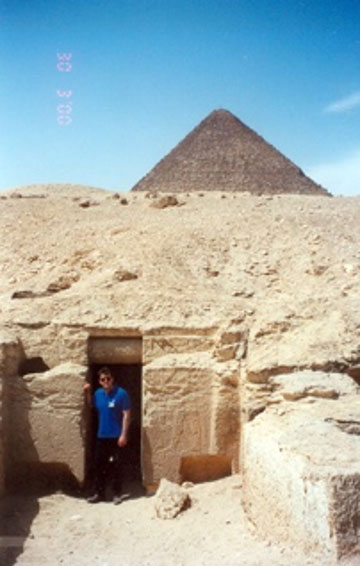
Panagiotis Kousoulis is Professor of Egyptology at the Department of Mediterranean Studies: Archaeology, Linguistics, International Relations (D.M.S.A.L.I.R.) of the University of the Aegean. He is the Director of the Laboratory for the Ancient World of the Eastern Mediterranean (established in 2015) and the scientific coordinator of the Egyptological Research Group Aegean Egyptology (established in 2003). He served as Vice Head of the D.M.S.A.L.I.R. (2018-2022) and Director of Studies for the Postgraduate Program “Archaeology of the Eastern Mediterranean” during the same period. He has been appointed academic coordinator of the D.M.S.A.L.I.R. for the Erasmus+ Program, academic advisor at Hellenic National Academic Recognition, alternate member of the Advisory Scientific Committee for issues concerning the Schools of Tourist Guides of the Ministry of Tourism, and expert/evaluator in European programs (Fund for Scientific Research – FNRS, Erasmus+, N.S.R.F., State Scolarship Foundations). During the period of May – July 2026, he served as a Visiting Professor at the Kolleg-Forschungsgruppe MagEIA, Julius-Maximilians-Universität Würzburg (Germany).
He studied Archaeology and History of Art at the National and Kapodistrian University of Athens, and Egyptology at postgraduate and doctoral level at the Universities of Birmingham and Liverpool (Great Britain). He served as a Postdoctoral Fellow of the State Scholarships Foundation at the University of Liverpool (2001-2002) and as a visiting professor at the same university (2006, 2008). He was the representative of Greece on the Council of the International Association of Egyptologists (2008-2015) and scientific associate of the Cultural Center of the Embassy of the Arab Republic of Egypt (2005-2015). He is a research member of the International Association of Egyptologists, the American Research Center in Egypt, the Egypt Exploration Society, the American Academy of Religion (invited speaker at the 49th Annual Meeting in San Francisco, 19-22/11/2011, thematic session “The Mediterranean Material Cultures and the Study of Religion – Understanding the Past””), the European Society for the Study of Western Esotericism και the Societas Magica.
His research interests focus on the ancient Egyptian religious system (ontology, theology, demonology, ritual, magic), funerary ideology and practice (archaeology of death), Egyptian language and writing (hieroglyphic, hieratic, Ptolemaic inscriptions), Egyptian and Egyptianizing votive offerings from archaic Greece (Aegyptiaca), cross-cultural relations in the Eastern Mediterranean during the Late Bronze Age and the Early Iron Age, the academic study of magic/demonology, and the reception of Egypt in Western esotericism.
P. Kousoulis has authored numerous articles in scientific journals, conference proceedings, and collective volumes, has participated as an invited speaker in many conferences and specialized workshops in Greece and abroad, and has organized seven international conferences on Rhodes and Athens: Ancient Egyptian Theology and Demonology (2003), Foreign Relations and Diplomacy in the Ancient World: Egypt, Greece, Near East (2004), First Egyptological Seminar on Rhodes (2005), Tenth International Congress of Egyptologists (2008), Εx Oriente Lux Ι: The Research and Teaching of the Egyptian, Near Eastern and Cypriot civilizations in Greek Academia (2011), Aegyptiaca Project: the Symposium: Religion, Politics and Culture in the Mediterranean from the 8th to 6th c. BC (2016), Current research in Egyptology 2021 (2021), Defining the anti-god category in the Egyptian belief system (2027).
From 2002 onwards, P. Kousoulis teaches specialized courses in Egyptology and Near Eastern archaeology at both undergraduate and postgraduate levels at the D.M.S.A.L.I.R. Under his supervision and scientific guidance, five doctoral dissertations and two postdoctoral research projects have been completed, while another five doctoral dissertations and three postdoctoral research projects are currently in progress.
Current research projects
[1] “Death, Magic, Eternal Life (DeMaEL): Mortuary artifacts and ideology from the Egyptian collection of the National Archaeological Museum (c. 1069-664 BC)” [Χρηματοδοτούμενο από το Ελληνικό Ίδρυμα Έρευνας και Καινοτομίας, στο πλαίσιο της «3ης Προκήρυξης και Οδηγού Διαχείρισης και Υλοποίησης Ερευνητικών Έργων για την ενίσχυση μελών ΔΕΠ και Ερευνητών/ριών» (Α.Π. 70402/28.07.2023, όπως ισχύει) στην Επιστημονική Περιοχή «Ανθρωπιστικές Επιστήμες και Τέχνες», στις Κατηγορίες Ι & ΙΙ, MΙS 26716]
URL: https://demael-aegean.gr | https://demael.gr
[2] “AegySca Project: Aegyptiaca as indicators of religious and cultural interaction in the Southeastern Mediterranean: The multiple implications of Egyptian and Egyptianizing scarabs in the Aegean, 8th-6th century BC”
[European Social Fund through the Operational Programme “Human Resources Development, Education and Lifelong Learning 2014-2020” (MΙS 5049415)]
URL: https://aegyptiaca.gr
[3] “Demon Things: Ancient Egyptian Demonology” (University of California, Berkeley, University of Chicago, University of the Aegean)
URL: https://voices.uchicago.edu/demonthings/about/
[4] “Aegyptiaca Project: Ecumene and Economy in the Horizon of Religion” (University of the Aegean, University of Bonn, Ephorate of Antiquities of Dodecanese)
URL: https://aegyptiaca.gr
[5] “Magical Interactivity in the Ancient Mediterranean (MagIAM): Phenomenology, Semantics, Performativity” (University of the Aegean)
Recent publications
[1] Kousoulis, P. (in press), Apep and the Anti-god Perception in the Egyptian Belief System. Archaölogie als Kulturwissenschaft, Reihe: Hans-Bonnet Studien zur Ägyptischen Religion, Eb-Verlag, Berlin.
[2] Κουσούλης, Π. (2026). Αιγυπτολογία: Πτυχές του Πολιτισμού της αρχαίας Νειλοχώρας [Προπτυχιακό εγχειρίδιο]. Κάλλιπος, Ανοικτές Ακαδημαϊκές Εκδόσεις. https://doi.org/10.57713/kallipos-1128
[3] Κουσούλης, Π. (2025), ‘Μαγεία και μύηση στον αιγυπτιακό Άδη: αρχαίες αναπτύξεις και σύγχρονες μεταπλάσεις’, Vortex 9, 54-67.
[4] Kousoulis, P. & Papadaki, Ch. (2024). ‘The Minoan genius and the issue of Creto- Egyptian interculturality in the demonological discourse’, in M. Tarasenko, L. Morenz, J. Baines (eds.), “Nobody Can Struggle Alone”. An Egyptological Volume on Behalf of Ukraine. Bonner Ägyptologische Beiträge 14, EB-Verlag, Berlin.
[5] Κουσούλης, Π. (2024), ‘Γεφυρώντας την Άβυσο: η Μαγεία της «άλλης» Αιγύπτου και η Αιγυπτιολογική Ορθότητα’, Vortex 7, 33-5.
[6] Κουσούλη, Π. (2023), ‘Το σώμα ως μαγική «εργαλειοθήκη»: η περίπτωση της αρχαίας Νειλοχώρας, στο Χρ. Παπαδάκη, Το Σώμα και η Μαγεία, Άλλωστε εκδόσεις, Αθήνα, 227-38.
[7] Κουσούλης, Π. & Παπαδάκη, Χρ. 2022, ‘Ανιχνεύοντας την ιστορία της “πεντάλφας” με αφορμή ένα θραύσμα κονιάματος από την Κνωσό’, In G. Vavouranakis and I. Voskos (eds), METIOESSA. Studies in Honor of Eleni Mantzourani. AURA Supplement 10, 288-302.
[8] Apostola, E., Kousoulis, P., Papadaki, Ch. 2021. ‘Egyptian and Egyptianizing scarabs in the Aegean (8th-6th BC): The Sanctuary of Hera Akraia-Limenia at Perachora as a case study’, Chronache di Archaelogia, 61-102.
[9] Kontogianni, Α., Ganetsos, Th., Zacharis, N., Kousoulis, P. and Papakitsos, Ev.C. (2021), ‘Α detailed study about Egyptian-Coptic and software engineering’, Archaeology, vol. 9, p. 1, 28-33.
Contact
Address: Demokratias 1, Building 7th March, Office Β25, Department of Mediterranean Studies: Archaeology, Linguistics, International Relations, University of the Aegean, Rhodes, Gr: 85132
Tel.: +30 22410 99341
Email: ko*******@****an.gr | eg********@****an.gr
Profile @ Academia: https://aegean.academia.edu/PanagiotisKousoulis
URL: http://aegeanegyptology.gr